Prohibited Items for Taiwan to Malaysia Shipping: Complete List
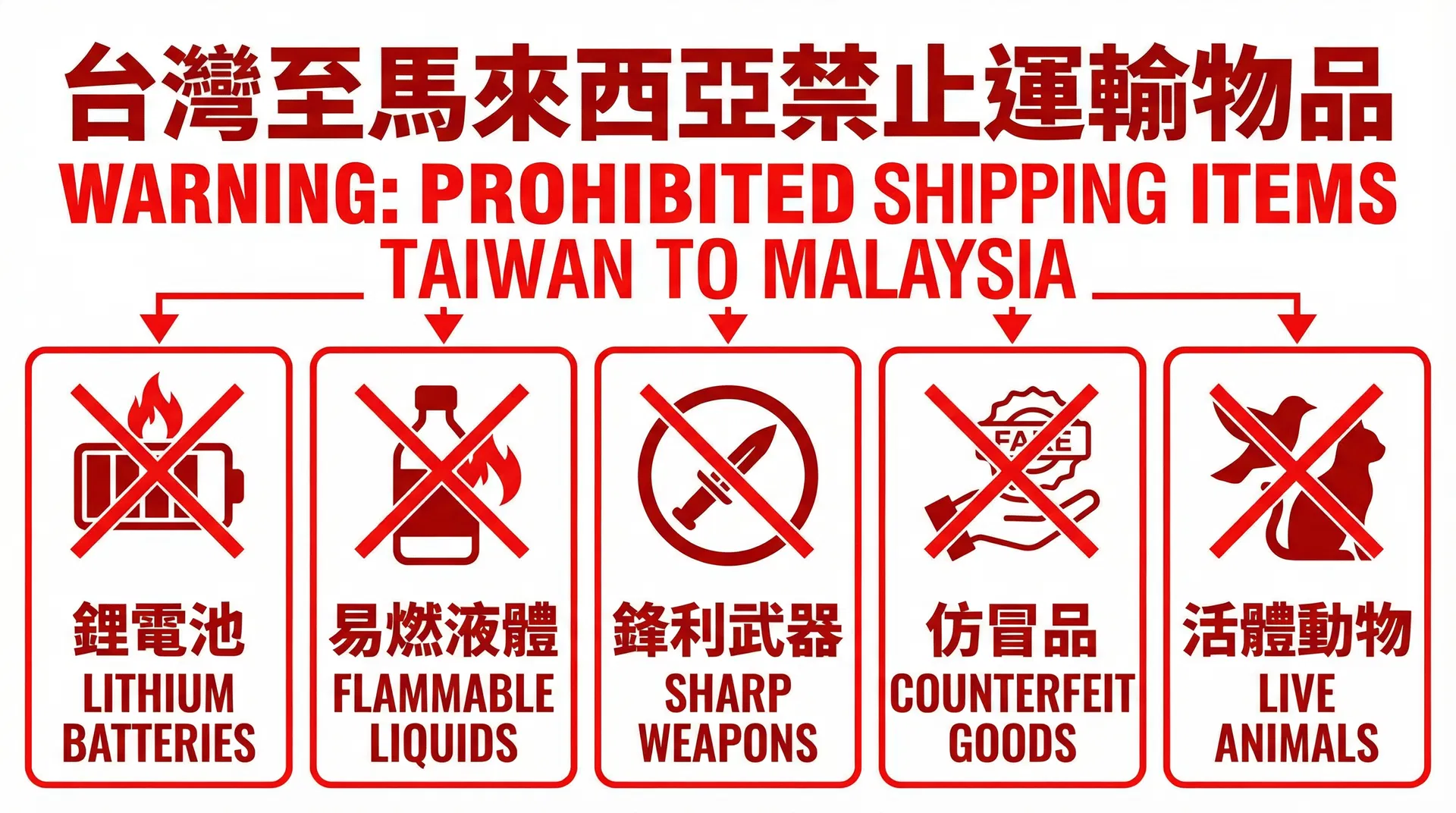
Shipping from Taiwan to Malaysia, weapons and ammunition, drugs and controlled substances, and pornographic material are absolutely prohibited; lithium batteries and dangerous goods are restricted by aviation rules; food, medicines, plants, animals and some electronics are restricted items that need permits. Working out which category your goods fall into before you pack is far cheaper than dealing with a seized parcel afterwards.
In this guide
- What is absolutely prohibited from Taiwan to Malaysia?
- What extra restrictions apply to air freight?
- Which imports does Malaysia require permits for?
- How do you tell prohibited, restricted and shippable items apart?
- How do you check an item before you ship it?
- What happens if you ship a prohibited item by mistake?
- Frequently Asked Questions
- Three things to do before you pack
What is absolutely prohibited from Taiwan to Malaysia?
Absolutely prohibited items are those no consolidator or courier will accept, no matter how they are declared, packed or described, and they fall into three groups: weapons and explosives, drugs and controlled substances, and pornographic material. There is no permit route for these. No exception clause exists, so the only correct decision is not to ship them.
Weapons and explosives
- Firearms and ammunition
- Explosives
- Grenades and other military weapons
- Replica weapons (which can be mistaken for the real thing)
Replica weapons are the trap here. Toy guns, airsoft equipment and film props may be sold freely in Taiwan, but anything that resembles a real firearm can be stopped at security screening or inspection, so it is not worth the risk.
Drugs and controlled substances
- Cannabis, heroin, cocaine and other narcotics
- Unauthorised controlled medicines
- Hallucinogenic substances
Note: Malaysia takes an extremely severe view of narcotics, and carrying or transporting drugs can carry the death penalty. Supplements, essential oils and foods containing cannabis derivatives may be legal elsewhere while remaining controlled in Malaysia, so read the ingredient list before you buy.
Pornographic material
- Pornographic publications and video
- Child sexual abuse material
Books, media and merchandise with adult content may be legally published in Taiwan and still be treated as prohibited imports in Malaysia. For ordinary printed matter, see shipping books and documents to Malaysia.
What extra restrictions apply to air freight?
Air freight restrictions cover goods that are perfectly legal to own but cannot fly safely, above all lithium batteries, compressed gases and flammable liquids. What blocks them is the transport mode rather than their import status, so sea freight is sometimes an alternative, but it still has to be confirmed case by case.
Lithium batteries
Lithium batteries are a major aviation restriction:
- Carry-on: under 100Wh may be carried; 100-160Wh needs airline approval
- Checked baggage / cargo:
- Loose lithium batteries: prohibited by air
- Batteries installed in equipment: allowed by air, subject to quantity limits
- Battery charge must be below 30%
Power banks, tool batteries and spare cells for devices all count as loose batteries, and they are among the most common items returned at the warehouse. For the full decision path see lithium battery shipping rules, and for battery-bearing gadgets see shipping electronics to Malaysia.
Dangerous goods (IATA classes)
- Class 1: explosives
- Class 2: compressed gases (lighters, aerosol cans)
- Class 3: flammable liquids (liquids over 70% alcohol)
- Class 4: flammable solids
- Class 5: oxidisers
- Class 6: toxic substances
- Class 7: radioactive material
- Class 8: corrosives
Class 2 catches people out most often: hairspray, sunscreen spray, hand sanitiser, insect spray and gas canisters are all either compressed gases or contain flammable propellant. See aerosol shipping restrictions. Class 3 shows up in high-strength alcohol, perfume and some cosmetics, covered in liquids, perfume and alcohol to Malaysia and cosmetics to Malaysia.
Liquid limits
Air freight applies strict limits to liquids:
- No more than 1 litre of liquid in total per parcel
- No single bottle larger than 500ml
- Alcohol strength limits apply
Liquids also carry a leak risk, and packing quality affects whether a shipment is accepted at all. See the consolidated shipping packing guide.
Which imports does Malaysia require permits for?
Restricted items can be imported, but only with a certificate or permit from the relevant authority, and the requirements cluster around food, medicines and supplements, plants and animals, and radio-communication electronics. Parcels without the paperwork are usually not destroyed outright; they sit in clearance waiting for documents.
Food
The following foods need special permits:
- Halal food: JAKIM halal certification
- Meat products: MAQIS permit and certificate of origin
- Plant-based food: phytosanitary certificate
- Dairy products: health certificate
The dried meat, sausage and pork floss found in Taiwanese festival hampers all count as meat products, and they are the single most common line crossed in personal parcels. For food generally see snacks and food to Malaysia; for certification questions see halal food and cosmetics import to Malaysia.
Medicines and health supplements
- Prescription medicines require NPRA (National Pharmaceutical Regulatory Agency) approval
- Health supplements require BPFK registration
- Traditional herbal remedies require BPOM certification
The border between a supplement and a medicine is easy to misjudge, and vitamins, enzymes and dried herbs are handled differently. See medicine shipping rules for Malaysia and supplements to Malaysia.
Plants and animals
- Live plants: phytosanitary certificate
- Live animals: CITES permit (endangered species)
- Animal products: veterinary health certificate
Seeds, bulbs, dried flowers and untreated wooden items can also fall inside quarantine scope. See plants, seeds and agricultural goods to Malaysia.
Electronics
- Radio-communication equipment: MCMC type approval
- Some electronics: SIRIM certification
Routers, walkie-talkies, Bluetooth devices and wireless cameras are all communication equipment, and certification is applied more strictly to commercial quantities than to a single personal device.
How do you tell prohibited, restricted and shippable items apart?
The difference between the three is how much room you have to fix the problem: none for prohibited goods, paperwork for restricted goods, and an honest declaration for everything else. Check in that order: absolute prohibition first, aviation restriction second, Malaysian import permits last.
| Category | Definition | Typical examples | Remedy |
|---|---|---|---|
| Absolutely prohibited | Accepted by no channel | Weapons, drugs, pornography | None; do not ship |
| Air-restricted | Limited by flight safety rules | Loose lithium batteries, aerosols, high-strength alcohol | Repack or consider sea freight, confirmed case by case |
| Import-restricted | Importable with a permit | Meat, medicines, live plants | Release once documents are supplied |
| High-value declarable | Shippable, must be declared | Jewellery, watches, precious metals | Declare honestly and keep receipts |
| Ordinary goods | Normal declaration only | Clothing, stationery, packaged snacks | Nothing extra needed |
High-value goods
- Jewellery and watches (declaration required above RM 500)
- Artwork and antiques
- Precious metals
For high-value goods the question is rarely whether you can ship them, but whether the declaration is honest and the cover is adequate. See declared value at Malaysian customs and luxury goods to Malaysia.
Tobacco and alcohol
- Cigarettes: 200 sticks per person
- Alcohol: 1 litre per person (non-Muslim)
- E-cigarettes: Malaysia restricts the import of e-cigarettes
Those allowances describe personal carriage, and consolidated freight is handled differently from accompanied baggage, so confirm the current treatment with our team before you buy.
How do you check an item before you ship it?
There are two routes: look up the HS code and read the import rules attached to it, or send the item name, ingredients and quantity to our team for a decision. Either way, defer to the current rules of the Malaysian authorities and of the carrier handling your shipment, because older information found online is frequently out of date.
Method one: look up the HS code
Every product has a corresponding HS code, which you can look up as follows:
- Go to the Royal Malaysian Customs Department website
- Search the HS code by product description
- Read the import rules attached to that code
The HS code drives both the tariff and the permit requirement. For how classification works in a consolidated shipment, see HS codes for consolidated shipping to Malaysia.
Method two: contact GoodVShare
If you are not sure whether an item can be shipped, contact GoodVShare customer service directly. Our team can help you judge whether the goods comply. Give us the product name, brand, ingredients or materials, quantity and whether it contains a battery, and the answer comes back much faster. For declaring in advance, see how to pre-declare parcels.
Common misconceptions
Misconception one: anything legal can be shipped Not necessarily. Some goods that are legal in Taiwan are restricted in Malaysia.
Misconception two: a low declared value avoids clearance Clearance is mandatory regardless of declared value, and under-declaring tends to attract customs attention rather than avoid it.
Misconception three: personal-use items need no permit Some goods require an import permit even for personal use.
What happens if you ship a prohibited item by mistake?
When a parcel contains a prohibited item or an undocumented restricted item, the usual outcomes in order of severity are a warehouse return, a customs hold pending documents, seizure and destruction, and in the worst cases legal action. The earlier it is caught, the cheaper it is to fix, which is why the warehouse check is the important line of defence.
In practice the sequence looks like this:
- Warehouse check: found during intake, the parcel is returned to a Taiwan address or abandoned, with limited loss.
- Export screening: stopped at aviation security, the parcel is returned and the whole shipment may be delayed.
- Import clearance: customs holds the goods and asks for documents; supply them and it is released, fail and it is seized.
- Legal liability: for narcotics, weapons and similar, liability rests with the sender and the recipient.
For what to do when a parcel is held, see parcel held by Malaysian customs. For which goods draw inspection, see high-risk items for customs inspection and the Malaysia customs clearance guide.
Frequently Asked Questions
Can I ship toy guns or airsoft equipment?
Replica weapons appear on the absolutely prohibited list, so anything closely resembling a real firearm should not be shipped. Parts such as magazines and sights may look harmless on their own but can still be treated as weapon components once assembled, so check before you send.
Can I ship toner or perfume that contains alcohol?
Liquids over 70% alcohol are IATA class 3 flammable liquids. Most toners sit well below that, while perfume is usually a high-alcohol product. Acceptance depends on concentration, volume and packaging, so defer to the carrier's current rules.
Can I send Taiwanese herbal medicine or herbal soup packs?
Traditional herbal remedies require BPOM certification, and a soup pack containing animal-derived ingredients also triggers the meat permit requirement. Personal quantities and commercial quantities are treated differently, so send us the full ingredient list first.
Can I ship an e-cigarette or heated tobacco device?
Malaysia restricts the import of e-cigarettes, and the devices normally contain a lithium battery as well, so a single item breaches both an import restriction and an aviation restriction. These are not suitable for consolidated shipping.
If one item in the box is prohibited, is the whole box seized?
It depends on the inspection outcome. The common result is that the shipment is paused, the offending item is removed and the rest is released, but a full return or a long delay is also possible. Packing uncertain items separately and declaring them in advance greatly reduces the risk to the rest of the box.
Three things to do before you pack
Most cross-border problems come from shipping without checking rather than from deliberate rule-breaking. Before you tape the box, do three things:
- Go through the box item by item, checking each one against the prohibited list, the aviation restriction list and the permit list. Batteries, liquids and anything containing meat go first.
- Get the paperwork before you ship. If an item is restricted, obtain the certificate first rather than sending it and hoping.
- Declare honestly. Fill in the product name, quantity and value accurately; under-declaring saves very little and invites inspection.
When you are ready, create an order, or check the acceptance conditions on the Taiwan to Malaysia air route. For the full process, see the complete Taiwan to Malaysia shipping guide. Declaring honestly and following the rules is what gets your parcel to its destination.