Shipping from Taiwan to Malaysia: The Complete 2026 Guide to Cost, Transit Time and Customs
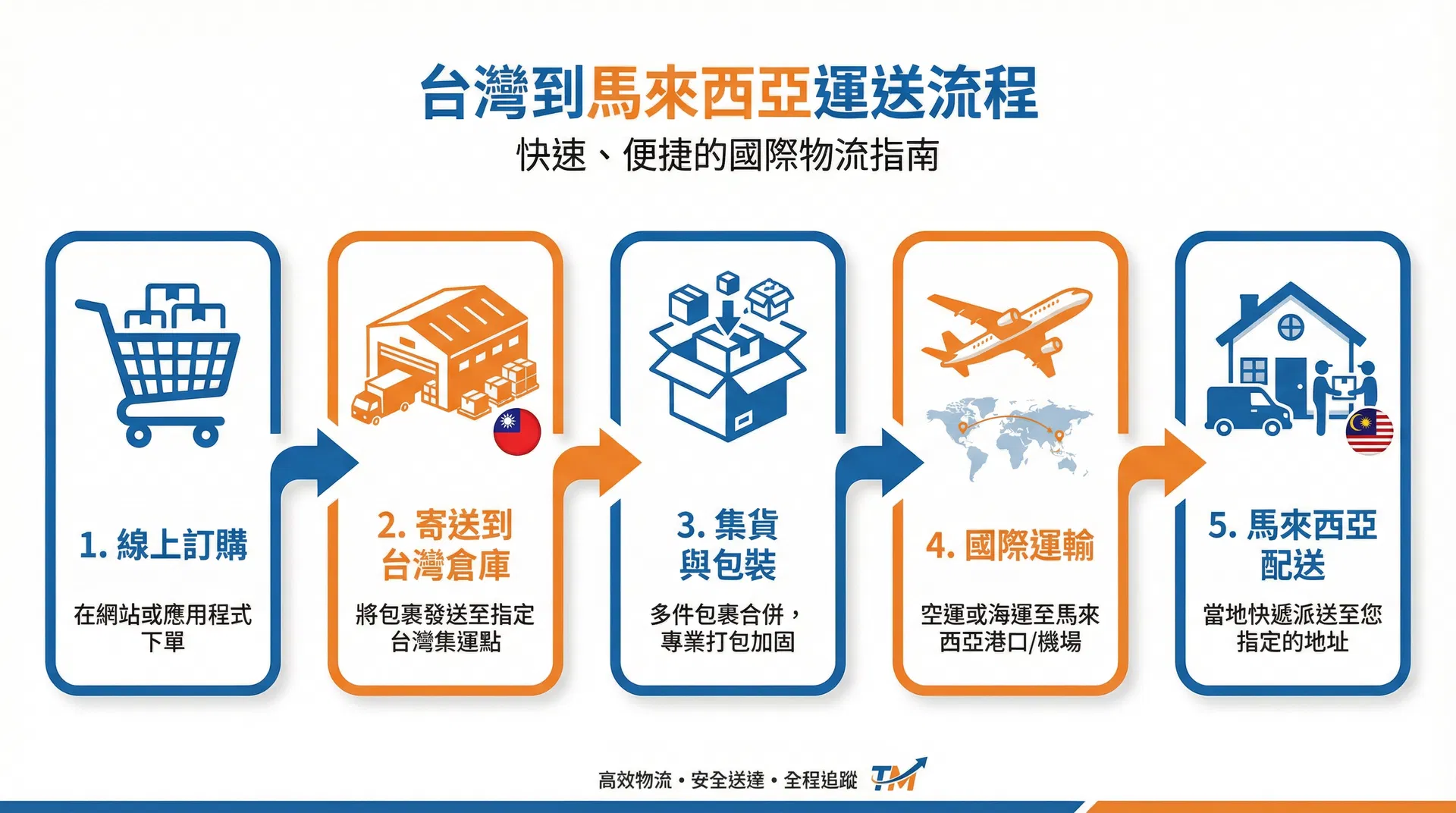
The simplest way to ship from Taiwan to Malaysia is consolidation with tax-inclusive clearance: your purchases gather at a Taiwan warehouse, ship out as one consignment, and both the Taiwan export declaration and the Malaysian import clearance and tax are handled for you, so the recipient pays nothing further on delivery. West Malaysia takes about 5 working days by air and about 30 working days by sea, and the freight is set by whichever is greater, actual weight or volumetric weight.
This is GoodVShare's master guide: get the full picture here, then open the deeper articles you actually need. Taiwanese electronics, cosmetics, health supplements, snacks and all kinds of online-shopping finds are in steady and growing demand among Malaysian buyers.
In this guide
- What is the core Taiwan to Malaysia service?
- How do you choose between air and sea freight?
- How is the freight actually calculated?
- How do transit times differ by route?
- What cannot be shipped to Malaysia?
- How do you send your first shipment with GoodVShare?
- Which article should you read for a specific topic?
- Frequently Asked Questions
- Three checks before you ship
What is the core Taiwan to Malaysia service?
GoodVShare's standard Taiwan to Malaysia service is tax-inclusive clearance, also called double clearance tax paid: export clearance in Taiwan, import clearance in Malaysia and import tax are all handled by us, the tax is already inside the freight, and the recipient pays nothing extra on delivery.
For the recipient, the quoted freight is the final figure, so no parcel gets stuck at the delivery stage waiting for a tax payment.
The rule of thumb is simple: as long as it is properly packed and contains no batteries, almost anything can ship. That is why ordinary online shopping, personal resale, gifting and small commercial consignments almost all travel this way. Only high-value goods, shipments that need a tax document for company accounts, or corporate consignees need to consider a formal declaration instead.
Here is how the two clearance models compare:
| Comparison | Tax-inclusive clearance | Formal declaration |
|---|---|---|
| Tax | Already included in the freight | Assessed on the actual tariff and paid separately |
| Tax certificate | Not issued | Formal entry document available for company accounts |
| Best for | Individuals, small values, ordinary consumer goods | Company imports, high-value goods, anyone needing documentation |
| Paperwork | Handled by the consolidator | Invoices, catalogues and specifications required |
| Timing | Runs on the normal consolidation schedule | Arranged case by case, longer lead time |
To understand how this clearance model works, and how it differs from DDP, read what is tax-inclusive clearance. For high-value goods, luxury items or business imports that need a tax certificate, use formal customs declaration, arranged separately, and weigh the two options with formal declaration versus tax-inclusive clearance. The Malaysian tax background is set out in Malaysia SST import tax explained.
How do you choose between air and sea freight?
There are only three questions: is it urgent, is it heavy, and is it bulky? Urgent, light, small and high-value goods go by air; heavy, large and bulky goods that can wait go by sea. Most first-time shippers put everything on a flight, then watch volumetric weight eat the budget, when splitting the consignment in two would have cost far less.
| Item | Air | Sea |
|---|---|---|
| Transit (West Malaysia) | About 5 working days | About 30 working days |
| Charged on | Actual vs volumetric weight, whichever is greater | Volume (CBM) |
| Volumetric formula | L x W x H (cm) divided by 5000, rounded up | Charged by CBM volume |
| Minimum charge | From 1 kg | From 0.5 CBM |
| Best for | Light, small, urgent items | Heavy, bulky, non-urgent items |
In short: urgent, light and small go by air; large, heavy and unhurried go by sea. For full guidance and worked examples, see air versus sea, how to choose, and for the real cost gap between the two, see air and sea cost case studies.
There is also a third approach that experienced shippers use constantly: split one batch into two consignments. Seasonal clothing, bedding and large household goods travel by sea, while the skincare, consumables or documents you need soon travel by air. You avoid flying a whole carton because of one urgent item, and you avoid making the thing you actually need wait a month.
How is the freight actually calculated?
Freight depends on weight, volume and route, and the two modes price on different logic. Air compares actual and volumetric weight and charges the greater; sea charges on volume. Once that clicks, you can bring the cost down at the packing stage rather than regretting it when the invoice arrives.
- Air: compares actual weight against volumetric weight (L x W x H divided by 5000), charges the greater and rounds up to the next whole kilogram, minimum 1 kg.
- Sea: charged on actual CBM volume with no rounding, minimum 0.5 CBM.
Working through the divisor this article already states makes it concrete:
| Scenario | Dimensions and actual weight | Volumetric weight (divided by 5000) | Chargeable by air |
|---|---|---|---|
| A carton of skincare | 40 x 30 x 30 cm, actual 9 kg | 36000 divided by 5000 = 7.2 kg | Charged at 9 kg |
| A carton of tissue paper | 60 x 50 x 40 cm, actual 6 kg | 120000 divided by 5000 = 24 kg | Charged at 24 kg |
| A carton of books | 30 x 25 x 20 cm, actual 8 kg | 15000 divided by 5000 = 3 kg | Charged at 8 kg |
All three examples make the same point: bulky goods are priced on volume, dense goods are priced on weight. If the second example went by sea instead, its volume is 0.12 CBM, well under the 0.5 CBM minimum, which is exactly when combining several orders into one box pays off. That is the value of consolidation.
For the full concept see volumetric weight explained, for estimating see the weight estimation guide, and for squeezing volume out of a carton see the packing guide.
Rates move with route and season, so to avoid quoting stale numbers we do not hard-code prices in articles. For live rates, message our LINE, or estimate with the shipping cost calculator guide and the online calculator. To check whether a quote has left anything out, read hidden fees in consolidation.
How do transit times differ by route?
Shipping to Malaysia is really three different operating conditions: West Malaysia, East Malaysia and Singapore, each with its own transit time and surcharges. Confirm which zone the delivery address falls in before you pick a shipping mode, and your delivery estimate will be far more reliable.
| Route | Transit (approx.) | Read more |
|---|---|---|
| Taiwan to West Malaysia | Air 5 days / Sea 30 days | Air, Sea |
| Taiwan to East Malaysia (Sabah, Sarawak) | Air 10 days / Sea 50 days | East Malaysia guide |
| Taiwan to Singapore | Air 7 days | Singapore guide |
| Malaysia to Taiwan (return) | Air 7 days | Return shipping guide |
East Malaysia incurs a remote-area surcharge; Singapore applies 9% GST, which is different from Malaysia's SST.
Each route also has its own landing page, so if you want the service detail directly, open East Malaysia air, East Malaysia sea, Taiwan to Singapore air or Malaysia to Taiwan air, or compare everything on the full route list. Singapore's tax regime differs from Malaysia's, as explained in Singapore GST on imports.
Last-mile rhythm also varies by city. For West Malaysia see shipping to Kuala Lumpur, shipping to Penang and shipping to Johor; for East Malaysia see shipping to Sabah and Sarawak. A badly written address is one of the most common causes of delay, so check the Malaysia address format guide before you ship, and see how the final leg works in Malaysian last-mile couriers explained.
What cannot be shipped to Malaysia?
The main restriction is batteries: lithium batteries, power banks and items with built-in batteries, with loose spare batteries especially prohibited by air. Explosives, weapons, drugs and controlled medicines, flammable liquids and similar goods are banned too. Checking before you buy is far easier than discovering afterwards that the item cannot leave the warehouse.
The categories that most often need confirmation in advance:
- Batteries and battery-powered goods: power banks, cordless tools and small appliances with lithium cells. See lithium battery shipping rules.
- Liquids, perfume and alcohol-based products: restricted on flammability and concentration grounds. See liquids, perfume and alcohol.
- Aerosols and pressurised cans: hairspray and spray sunscreen count as pressurised containers. See aerosol spray restrictions.
- Powders: milk powder, protein powder and powdered supplements attract inspection. See powder products shipping.
- Medicines and medical devices: mostly controlled. See medicine shipping rules for Malaysia.
- Food and cosmetics: some items must meet local certification. See halal certification and food and cosmetics imports.
The complete allowed and prohibited list is in prohibited items for Taiwan to Malaysia shipping. Import rules are set by the Malaysian authorities and do change, so whether a given item may be imported is always governed by the current local rules; if you are unsure, ask before you ship rather than relying on memory. Categories that draw inspection are listed in high-risk items for customs inspection.
How do you send your first shipment with GoodVShare?
The whole process is four steps: create an account, create a label, ship to the Taiwan warehouse, then wait for despatch and track. The step that trips up first-timers is the third one, because a carton without a member code written on it cannot be matched to an owner.
- Create an account and receive your member code, which acts as your shipping mark.
- Create a label: enter recipient details, item description and declared value, then choose air or sea.
- Ship to the Taiwan warehouse: the air warehouse is in Dayuan, Taoyuan and the sea warehouse is in Xitun, Taichung. Attach the label or write the member code on the carton. For the current warehouse address, type "warehouse" to our LINE.
- Wait for despatch and track: you are notified on arrival, then the shipment is arranged with tracking throughout.
The step-by-step detail is in the complete GoodVShare tutorial. Taken separately, how to fill in a pre-declaration is covered in how to pre-declare parcels, labelling and choosing the right warehouse in labelling and shipping to the warehouse, and progress checking in how to track a consolidated parcel. What actually happens inside the facility is described in warehouse operations explained.
Declared value is not an arbitrary number, and understating it tends to invite inspection rather than avoid it; see how to declare value for Malaysian customs. Consolidation carries no insurance, so for anything valuable read how to reduce the risk, and if something does arrive damaged or short, follow damage and loss claims.
Which article should you read for a specific topic?
The section below is the map of the whole site. Jump straight to the article that matches your situation, your goods and your destination rather than reading everything in order, since most topics are split across several deeper pieces.
By product category (what ships, how, and whether tax applies): supplements and vitamins, cosmetics and skincare, baby products and formula, 3C electronics, fashion, shoes and bags, snacks and edible gifts, luxury goods, pet supplies, tea and coffee, figures and collectibles and contact lenses and medical goods, with overviews in popular consolidation items and popular Taiwanese products in Malaysia.
Large and special items: large furniture and appliances, musical instruments, knives and tools, second-hand items, books and documents, wedding supplies, plants, seeds and agricultural goods and chemicals and industrial goods.
By Malaysian region: Kuala Lumpur and Selangor, Penang and the north, Johor and JB, Sabah and Sarawak.
Cost and saving: volumetric weight explained, air and sea cost case studies, hidden fees, seven ways to cut freight cost and consolidation versus express couriers.
Customs and tax: Malaysia SST import tax, how to declare value, what to do when a parcel is held, JAKIM halal certification, what an HS code is and the Malaysia customs clearance guide.
Shipping process: how to pre-declare, labelling and shipping to the warehouse, tracking parcels, damage and loss, the packing guide, failed delivery in Malaysia and cross-border returns and exchanges.
By situation: Taiwan Shopee, PChome and momo, Lazada and TikTok Shop fulfilment, students shipping home, relocating to Malaysia, sending gifts, the beginner's guide for Malaysian resellers, Taiwanese sellers shipping out, Malaysian sellers sourcing from Taiwan and how to choose a consolidator.
Festivals and scheduling: Chinese New Year scheduling, Hari Raya stocking, Deepavali stocking, Double 11 cross-border stocking and the Malaysian logistics calendar.
Brands and business needs: Taiwan brands expanding into Malaysia, moving back to Malaysia, all solutions, brand expansion into Malaysia and the Malaysian e-commerce market entry guide. If a term is unfamiliar, check the logistics glossary.
Frequently Asked Questions
Can I ship food and supplements to Malaysia?
Mostly yes, but they must meet Malaysia's import rules, and some foods need JAKIM halal certification or a MAQIS permit. Ingredient labelling, packaging integrity and whether the product contains animal-derived material all affect whether it clears smoothly, and the governing requirements are always the Malaysian authorities' current rules. See the Malaysia customs clearance guide and, for edibles specifically, snacks and food to Malaysia.
Does the recipient pay tax on delivery?
With tax-inclusive clearance the freight already covers Malaysian clearance and tax, so nothing further is due on delivery, aside from the East Malaysia remote surcharge and high-value goods that require a formal declaration. If you receive a message claiming to be from customs or a courier and asking you to transfer money for tax, check with us before acting; how to spot these is covered in the parcel scam prevention guide.
Can I combine several parcels into one shipment?
Yes, and this is the single biggest advantage of consolidation, because merging several purchases into one consignment spreads the freight. In practice you send everything bought in the same period to the same warehouse under the same member code, then ship once the box is full. Note that the air and sea warehouses are different addresses, so choosing the wrong one will break the consolidation. Techniques for combining and saving are in seven ways to cut freight cost.
How long does the whole thing take?
West Malaysia is about 5 working days by air and about 30 working days by sea, and East Malaysia and Singapore are in the route table above. Those figures run from despatch out of Taiwan, so they do not include the time for a Taiwanese seller to deliver to the warehouse, nor the time your carton waits for consolidation. Build both of those into your plan. Peak-season scheduling is covered in the Malaysian logistics calendar.
When is the freight confirmed?
The final freight is produced after the parcel arrives and is weighed and measured. Anything calculated beforehand is an estimate, because real dimensions and the weight of the outer carton both change the result, which means your packing directly changes what you pay. To get a range in advance, use the online calculator or the shipping cost calculator guide.
Are East and West Malaysia shipped on the same terms?
No. East Malaysia, meaning Sabah and Sarawak, needs an extra transhipment leg, so transit is longer than West Malaysia and a remote-area surcharge applies. Stocking and festival planning need to start earlier there. See the East Malaysia guide, plus East Malaysia air and East Malaysia sea.
Three checks before you ship
Reduced to its essentials: first, confirm whether the delivery address is West Malaysia, East Malaysia or Singapore, because transit times and surcharges differ; second, compare actual against volumetric weight once, and let that decide air or sea rather than forcing bulky goods onto a flight; third, pack properly, include no batteries, and ask about anything you are unsure of before shipping.
Ready? Get a cost range from the online calculator, then create a shipping label. If it is your first time, follow the complete tutorial end to end, and review service details on the full route list. For anything else, see the FAQ and support page.